
Building an AI Roadmap That Drives Real Business Value
INDUSTRY
Updates
Moving Beyond AI Experimentation
Artificial intelligence is no longer a future ambition. It is already embedded across the enterprise. 88% of organizations report regular AI use in at least one business function in 2025, up from 78% in 2024¹.
Yet despite this momentum, the performance gap is widening. 95% of generative AI pilots are failing to deliver meaningful financial results, and only 5% successfully scale to enterprise-wide impact².
This is not a technology problem. It is an execution problem.
Organizations are hitting what is often called pilot purgatory. AI works in controlled environments, but when it moves into the enterprise, progress stalls. The root cause is consistent. AI is still treated as a technical experiment rather than a shift in how the business operates.
To move forward, organizations need more than pilots. They need a structured, value-driven AI roadmap.
Why AI Pilots Succeed but Scaling Fails
Most organizations are still in the experimentation or piloting phase. Nearly two-thirds have not yet begun scaling AI across the enterprise¹. This highlights a fundamental gap between early success and enterprise readiness.
AI pilots are designed for speed and proof of concept. They operate with clean data, limited scope, and minimal constraints. At scale, that environment changes.
What breaks is not the model. It is the context.
AI becomes disconnected from core workflows, making it optional rather than essential. Data that looked usable in pilots becomes fragmented and inconsistent across systems. Governance requirements expand, introducing new layers of complexity. At the same time, many initiatives struggle to demonstrate real business value, focusing on novelty instead of measurable outcomes. Adoption slows further when employees are not trained or incentivized to integrate AI into their daily work.
These challenges compound quickly. What starts as momentum turns into friction. Without structural alignment, scaling stalls.
What’s Actually Holding AI Back at Scale
Scaling challenges rarely come from the model itself. They come from the environment it operates in.
Many organizations experience rapid, decentralized experimentation. Teams adopt different tools, vendors, and approaches. Early on, this feels like progress. Over time, it creates fragmentation, and fragmentation becomes a barrier to scale.
This is where the gap between pilot success and production readiness becomes clear.
AI pilots operate in controlled conditions. Enterprise environments do not. Legacy systems introduce integration complexity. Data becomes siloed across business units. Governance requirements expand. What worked in isolation struggles in real operating conditions.
Even when organizations improve data quality, deeper issues persist. Data remains disconnected across systems and often locked in unstructured formats. These are not just technical limitations. They directly impact AI’s ability to scale and deliver consistent outcomes.
As a result, organizations experience compounding friction. AI remains incremental rather than transformative. Costs become harder to predict. Integration slows. Operational risk increases. Teams operate in increasingly complex environments that are difficult to sustain.
This is not an execution failure. It is a structural gap.
Organizations that scale successfully are not those running the most pilots. They are the ones that align their operating model, data strategy, governance, and technology foundation before expanding AI across the enterprise³.
Building an AI Roadmap That Drives Value
To break out of pilot purgatory, organizations need a clear and structured roadmap that aligns AI with business priorities and operational realities. An artificial intelligence roadmap is a plan that outlines the steps an organization will take to implement and scale AI technologies effectively⁴. It serves as a guiding framework to align initiatives with business objectives, manage resources, and prioritize activities.
There is no one-size-fits-all roadmap. The right approach depends on an organization’s maturity, priorities, and constraints. The focus should be on selecting the right actions and sequencing them effectively, from foundational capabilities to more advanced use cases.
Successful roadmaps start with business outcomes. Organizations that generate real value anchor AI initiatives in measurable impact, whether that is revenue growth, cost reduction, or improved customer experience. They focus on solving meaningful operational challenges and define success using business KPIs rather than technical metrics.
From there, readiness becomes critical. Scaling AI depends on the strength of the foundation. This includes data quality and accessibility, system integration capabilities, governance frameworks, and organizational readiness. Without this alignment, even high-potential initiatives struggle to move beyond early experimentation.
Prioritization is equally important. Leading organizations focus on a mix of quick wins and scalable use cases. High-impact areas often include intelligent document processing, customer support automation, predictive analytics, and internal knowledge assistants. These use cases are both practical and repeatable across the enterprise.
Designing for scale from the outset is essential. Organizations that succeed build reusable data pipelines, standardize platforms, and avoid overly customized solutions that create long-term complexity. Scalability is built into the architecture, not added later.
Governance must also be embedded early. Clear ownership, accountability, and responsible AI policies are critical to reducing risk and enabling trust. Integrating compliance, privacy, and security into the design phase ensures that solutions can scale without disruption.
Finally, change management plays a central role. AI adoption is as much a people challenge as it is a technical one. Organizations that invest in training, align incentives, and empower internal champions see faster adoption and stronger outcomes. When employees view AI as an enabler rather than a disruption, value is realized more quickly.
Moving Toward AI Maturity
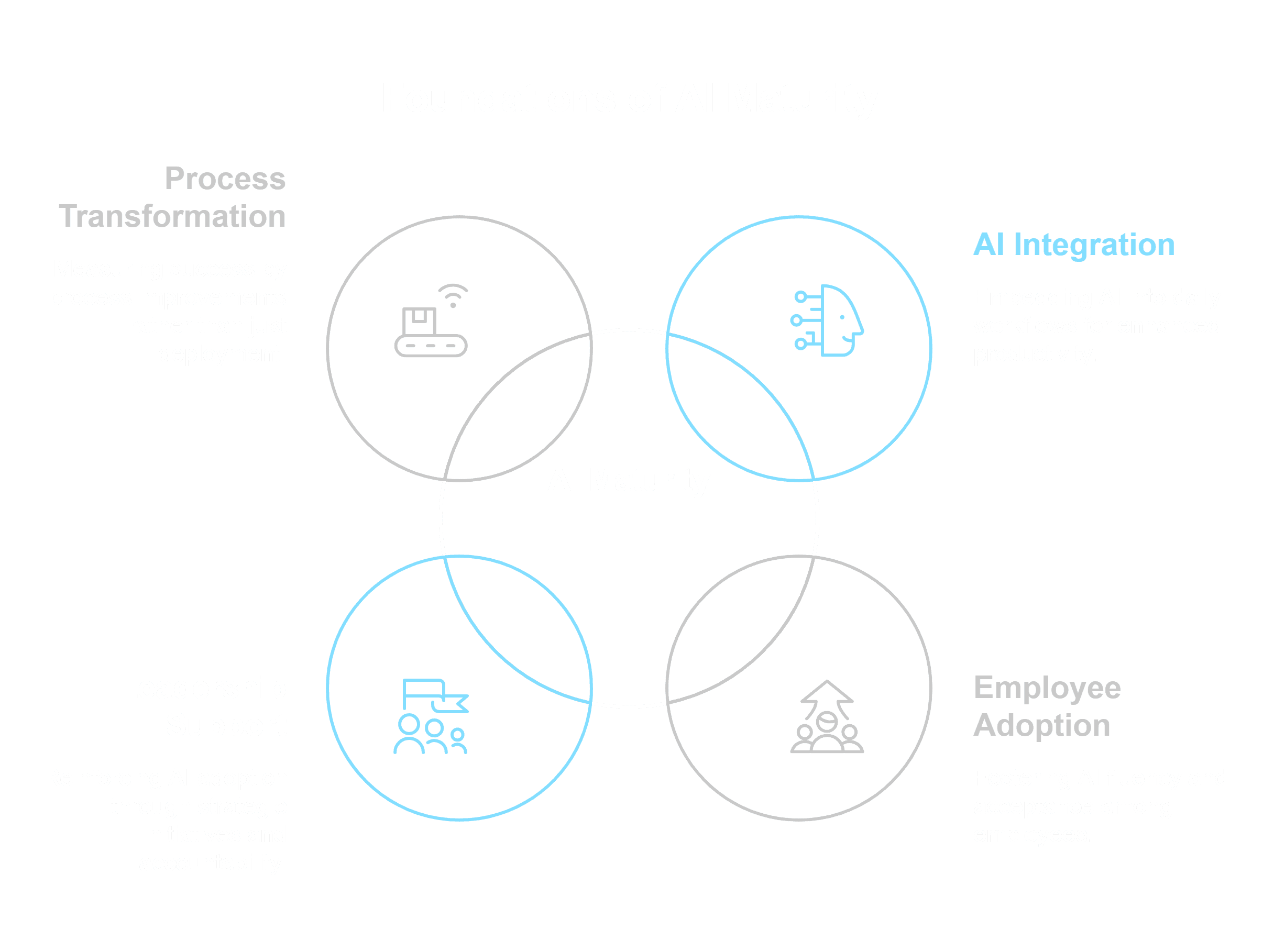
AI maturity is not defined by the tools an organization deploys. It is defined by how effectively AI is embedded into how work gets done.
Organizations can invest in advanced AI frameworks, but without adoption, impact remains limited. Resistance at the middle-management layer, misaligned incentives, and lack of workflow redesign can quietly stall progress. Without rethinking how work is executed, AI remains an incremental layer rather than a transformative capability.
Mature organizations take a different approach. AI becomes part of daily workflows. Employees see it as a capability multiplier. Leadership reinforces adoption through strategy, incentives, and accountability. AI fluency becomes part of hiring and performance expectations. Success is measured by process transformation, not just deployment.
Conclusion: From Experimentation to Competitive Advantage
The path to AI success is not about running more pilots. It is about building the foundation to scale what works.
Organizations that succeed treat AI as an operating model shift. They align initiatives with measurable business value. They invest in data, governance, and infrastructure. And they prioritize adoption as much as technology.
The opportunity is significant. But so is the execution challenge.
Competitive advantage will not come from access to AI. It will come from the ability to operationalize it at scale, consistently and effectively.
And that starts with a roadmap.
For organizations looking to move beyond experimentation, this is where a more structured approach becomes critical. At Inscend AI, the focus is on helping teams translate early AI momentum into scalable, business-driven execution through clear roadmaps, prioritized use cases, and the right operating foundation.
If the focus is on measurable outcomes, not just deployment, you can explore how leading organizations are connecting AI strategy to real business impact here.
The next phase of AI is not about doing more. It is about doing it right and doing it at scale.
Sources
The State of AI in 2025: Agents, Innovation, and Transformation, McKinsey & Company
MIT, 2026
The State of AI in 2025: Agents, Innovation, and Transformation, McKinsey & Company
The CIO’s Guide to Building an AI Roadmap That Drives Value, Gartner


