
The Questions Leaders Are Asking About AI And the Answers That Matter in 2026
INDUSTRY
Updates
Artificial intelligence is already shaping how modern organizations operate whether leaders have made a formal decision about it or not. It is showing up in day-to-day workflows, in how employees search for information, and in the speed at which decisions are expected to happen. In many organizations, AI adoption is happening informally, driven by teams experimenting on their own rather than through coordinated strategy.
At the same time, most organizations are still early in their journey. Nearly two-thirds have not begun scaling AI across the enterprise and remain in experimentation or pilot mode rather than moving toward sustained execution¹. The gap is not a lack of belief in AI’s value. It is uncertainty about how to move from experimentation to real, repeatable impact.
Investment trends make it clear that AI is not a passing phase. The global market for AI technologies reached approximately $244 billion in 2025 and is projected to exceed $800 billion by 2030². The question leaders are grappling with now is no longer whether AI matters, but how to approach it with enough clarity and discipline to make it work in practice.
What Does AI Actually Mean for a Business Today?
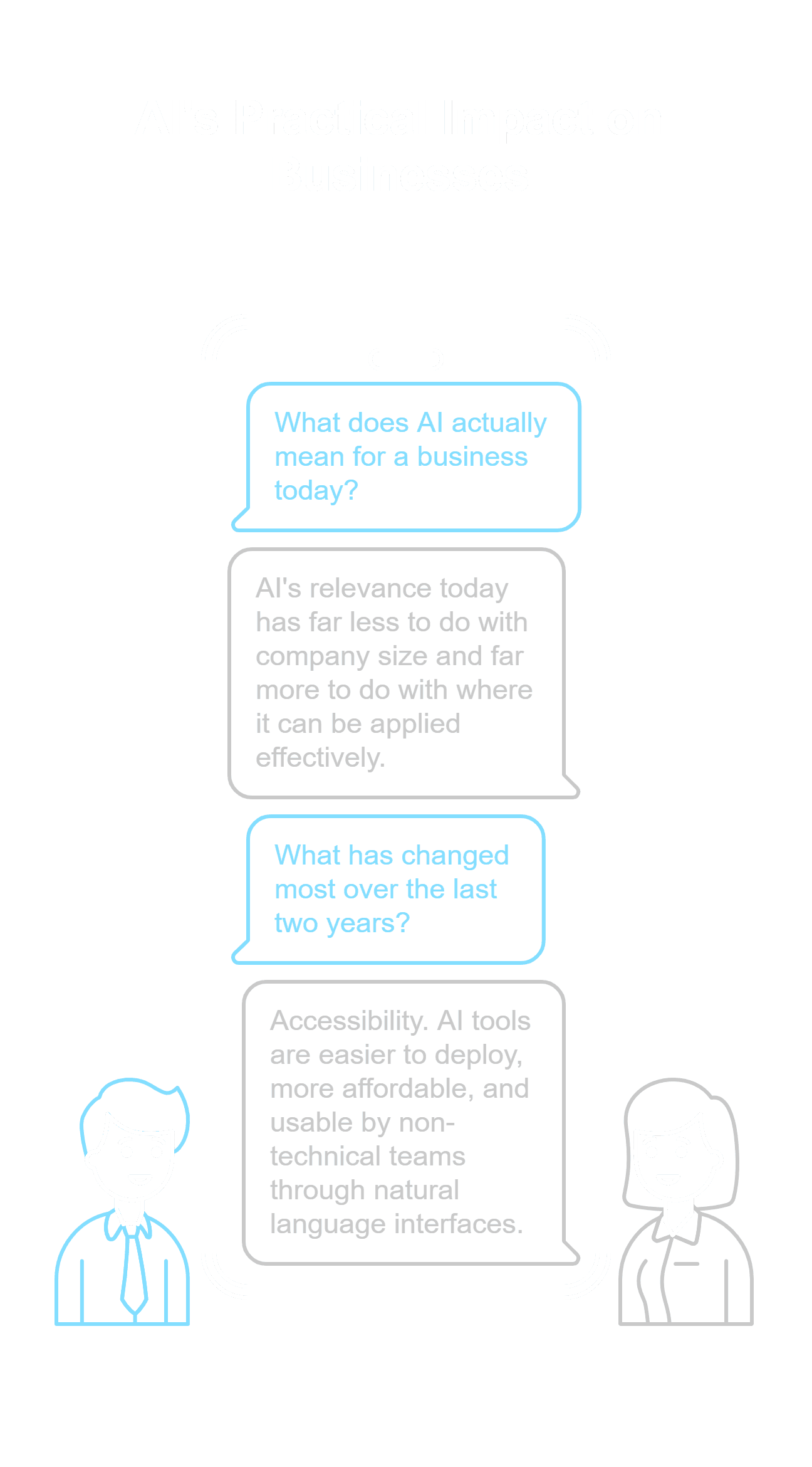
It is easy to assume that artificial intelligence is still the domain of large enterprises with massive budgets and dedicated data science teams. In practice, that assumption has become one of the biggest blockers to progress. AI’s relevance today has far less to do with company size and far more to do with where it can be applied effectively.
The data reflects this shift. Fifty-seven percent of U.S. small businesses are now investing in AI, up from 36 percent in 2023³. At the same time, AI has moved from novelty to habit inside the workforce. Three in ten employees now use AI daily, and 61 percent say their usage has increased compared to last year⁴.
At its most practical level, AI is about reducing friction in how work gets done. It automates repetitive decisions, accelerates access to information, and supports better judgment inside everyday workflows. These are not edge cases. They are operational challenges faced by organizations of every size.
What has changed most over the last two years is accessibility. AI tools are easier to deploy, more affordable, and usable by non-technical teams through natural language interfaces. This shift has quietly reset expectations. Employees now assume systems should be smarter, and leaders expect insights to move faster. In this environment, AI becomes an operational capability rather than a technology experiment.
How Should Organizations Get Started with AI?
The most common mistake organizations make when starting with AI is leading with tools instead of problems. Pressure to act often results in pilots that look impressive in isolation but fail to change how work actually happens.
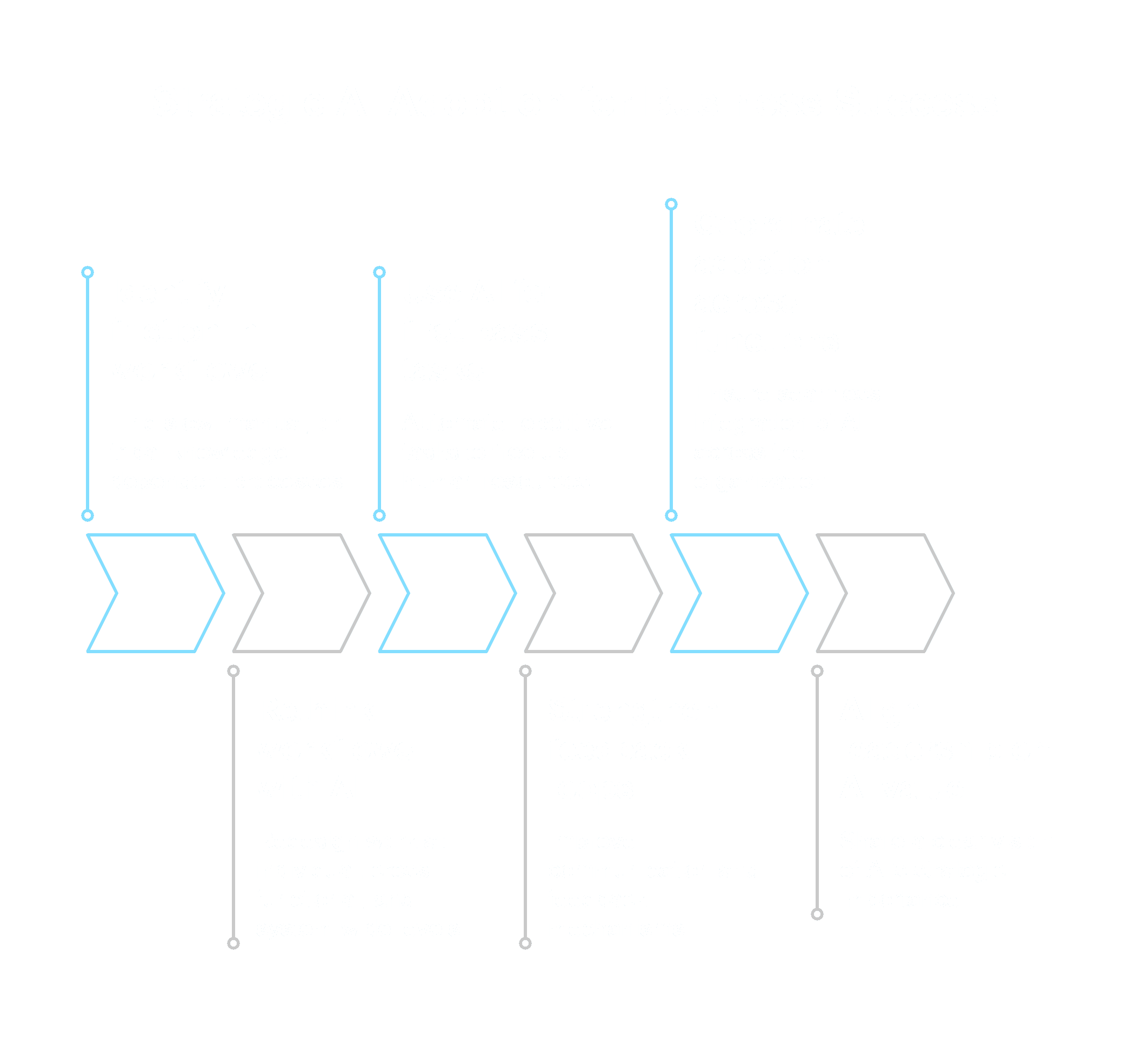
A more effective starting point is to identify friction. Look for workflows that are slow, manual, or overly dependent on tribal knowledge. Look for teams that spend more time moving information around than acting on it. These are the environments where AI tends to deliver early value.
AI delivers meaningful impact only when organizations rethink workflows rather than layering tools on top of existing processes. Leading organizations redesign work at the individual, cross-functional, and system-wide levels. They use AI for first-pass tasks, strengthen feedback loops, and coordinate adoption across functions. Without a connected view, productivity gains in one area often create bottlenecks elsewhere.
Alignment plays a critical role. When leadership shares a clear view of how AI creates value and differentiation, it drives focus and cultural momentum. When that internal alignment is paired with industry context, organizations are better positioned to move decisively rather than reactively.
What Is AI Readiness Really?
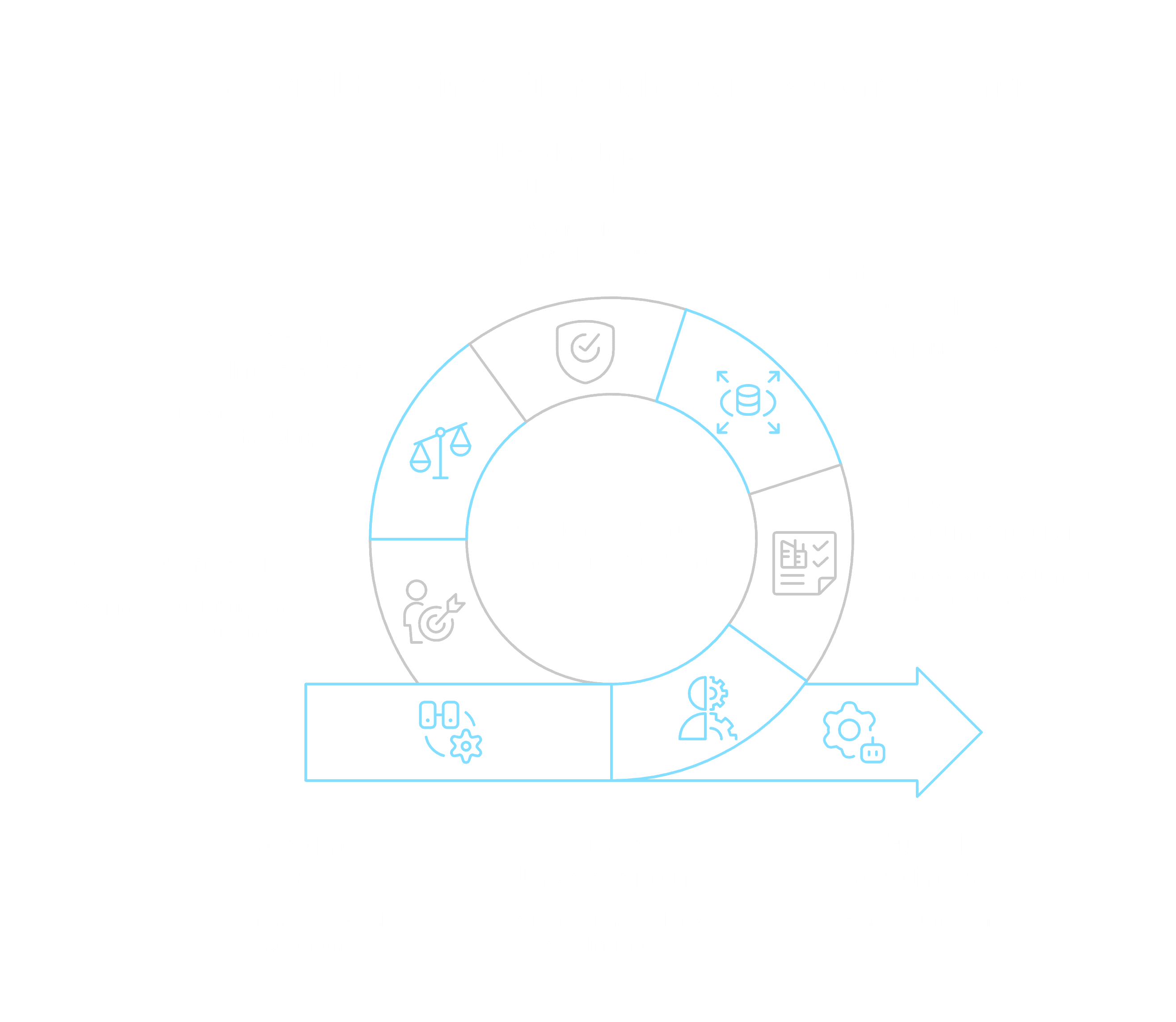
AI readiness is often framed as a technology question. In reality, it is an organizational one. Most companies do not struggle with AI because the models are inadequate. They struggle because the surrounding systems people, processes, and governance are not prepared.
True readiness shows up in a few consistent ways. Teams understand what AI can and cannot do. Processes are documented well enough to support automation. Data is accessible and reasonably reliable even if it is not perfect. Leadership has established clear guardrails for responsible use.
Governance is especially important. When integrated into daily work, governance does not slow teams down. It builds trust and confidence. Employees are more likely to use AI effectively when expectations are clear and safeguards are in place.
One of the most common gaps organizations face is ownership. When AI initiatives do not clearly belong to anyone, they lose momentum. Readiness means accountability for outcomes, not just experimentation.
Can You Be AI-Ready Without Perfect Data?
Yes. Waiting for perfect data is one of the fastest ways to stall progress. While data quality matters, most early AI use cases do not require pristine datasets across the entire organization.
What they do require is focus. Identify the data that supports the specific workflow you are improving, clean that subset, and build from there. AI maturity develops iteratively.
Generative AI has also changed long-standing assumptions about data readiness. Organizations no longer need perfectly structured data to begin realizing value. AI can drive learning, experimentation, and improvement from day one. As AI becomes embedded in workflows, it often improves data quality through use rather than waiting for ideal conditions.
In this model, AI becomes a catalyst for data maturity rather than something that depends on it.
How Has the AI Landscape Changed in the Last Two Years?
Two years ago, most organizations approached AI cautiously. Pilots were isolated, governance was unclear, and AI felt optional. Today, the tone is different.
More than two-thirds of organizations now use AI in more than one function, and half use it in three or more functions.⁵ AI is increasingly embedded into production systems. Agent-based approaches are emerging, where AI executes multi-step workflows under human oversight rather than simply responding to prompts.
Familiarity has grown just as quickly. Employees expect AI-assisted tools, and customers notice when experiences fall behind. The shift is not only technological. It is cultural. AI is becoming part of how work gets done regardless of whether organizations planned for it.
Adoption data reinforces this trend.⁶ ChatGPT now has more than 800 million weekly active users, and in October 2025 alone, Google Gemini recorded 1.2 billion visits and more than 206 million unique users.⁷ These numbers reflect both rapid adoption and accelerating innovation.
As 2026 unfolds, AI is moving decisively from experimentation to embedded, production-grade execution.
What Will Matter Most as We Move Through 2026?
As AI becomes more common, differentiation will come from execution. Organizations that invest in AI fluency, governance, and integration will pull ahead. Those that treat AI as a collection of disconnected experiments will struggle to scale value.
By 2026, competitive advantage will not come from access to advanced models. It will come from knowing how to deploy them responsibly, align them to real work, and continuously improve collaboration between humans and systems.
The organizations that succeed will treat AI as a core capability. Something to be built, refined, and governed with the same rigor as any other critical function.
The question leaders face now is no longer whether AI belongs in their organization. It is whether they are building the clarity and capability required to make it work consistently and at scale.
Sources:
The state of AI in 2025: Agents, innovation, and transformation, McKinsey and Company
Statista, Artificial Intelligence Market Size Worldwide
AI Adoption Survey, Business.com and Dialog
Ibid
The state of AI in 2025: Agents, innovation, and transformation, McKinsey and Company
Tech Trends 2026, Deloitte Insights
Google Gemini Statistics: Key Insights and Trends 2025, DO IT Software


