
A Practical Guide to Training AI on Your Business
SERVICE
AI Strategy
Artificial intelligence is no longer the hard part. The real challenge is making it relevant to your organization.
As more companies adopt AI, a key question keeps coming up: How do you train AI on your business so it delivers real value? Many teams find that while AI tools are powerful, their outputs often feel generic. The responses lack your company’s voice, processes, and specialized knowledge.
That is where most AI initiatives stall. The technology works, but it does not fit.
AI becomes truly valuable only when it is trained on your business context. The good news is that this is easier than ever. You do not need a data science team or a complex infrastructure. Success comes from structuring your knowledge, choosing focused use cases, and using modern AI tools effectively.
What It Means to Train AI on Your Business
When people think of training AI, they often imagine building models or writing code. In most cases, that is not what is required.
Training AI on your business is about shaping how it behaves using three key elements: context, structure, and guidance.
At its core, business AI training means enabling an AI system to correctly interpret your information so it can perform tasks with accuracy and consistency. It mirrors how people learn through exposure to relevant data, examples, and practice.
AI needs access to your processes, documentation, and knowledge. That information must be organized so the system can interpret it, and it needs clear rules for how to respond, including your tone, policies, and constraints.
When you combine these elements, AI evolves from a general assistant into a business-aware system that supports real work. Even without automation, a trained AI can transform team performance by delivering faster, more consistent, and context-aware results.
Modern Ways to Train AI: Context Before Code
Today, business AI training does not always mean retraining a model. Most companies use two proven methods:
Retrieval-Augmented Generation (RAG): The AI connects to your documents, FAQs, or reports and uses that data to answer questions. It is ideal for internal knowledge, customer service, and compliance because it keeps your data private.
Fine-tuning: When tone and reasoning are critical, you can fine-tune a model on your own content to match your language and logic. This works well for sales dialogues, content creation, or branded messaging.
Most organizations start with a RAG setup, which is faster and more secure, and expand into fine-tuning once workflows stabilize.
Why Organization and Data Quality Come First
Many businesses expect AI to figure it out. In reality, AI reflects the quality of what it is given. If your information is scattered or inconsistent, the results will be too.
The real foundation of AI success is operational, not technical. Before implementing tools, centralize your documentation such as SOPs, FAQs, policies, and playbooks. Keep it clean, current, and useful.
You are no longer documenting your business just for people. You are documenting it for AI.
Key Areas to Train AI for Business Impact
Instead of trying to cover the whole company, focus on a few high-impact areas first. These functions often show the fastest return on investment.
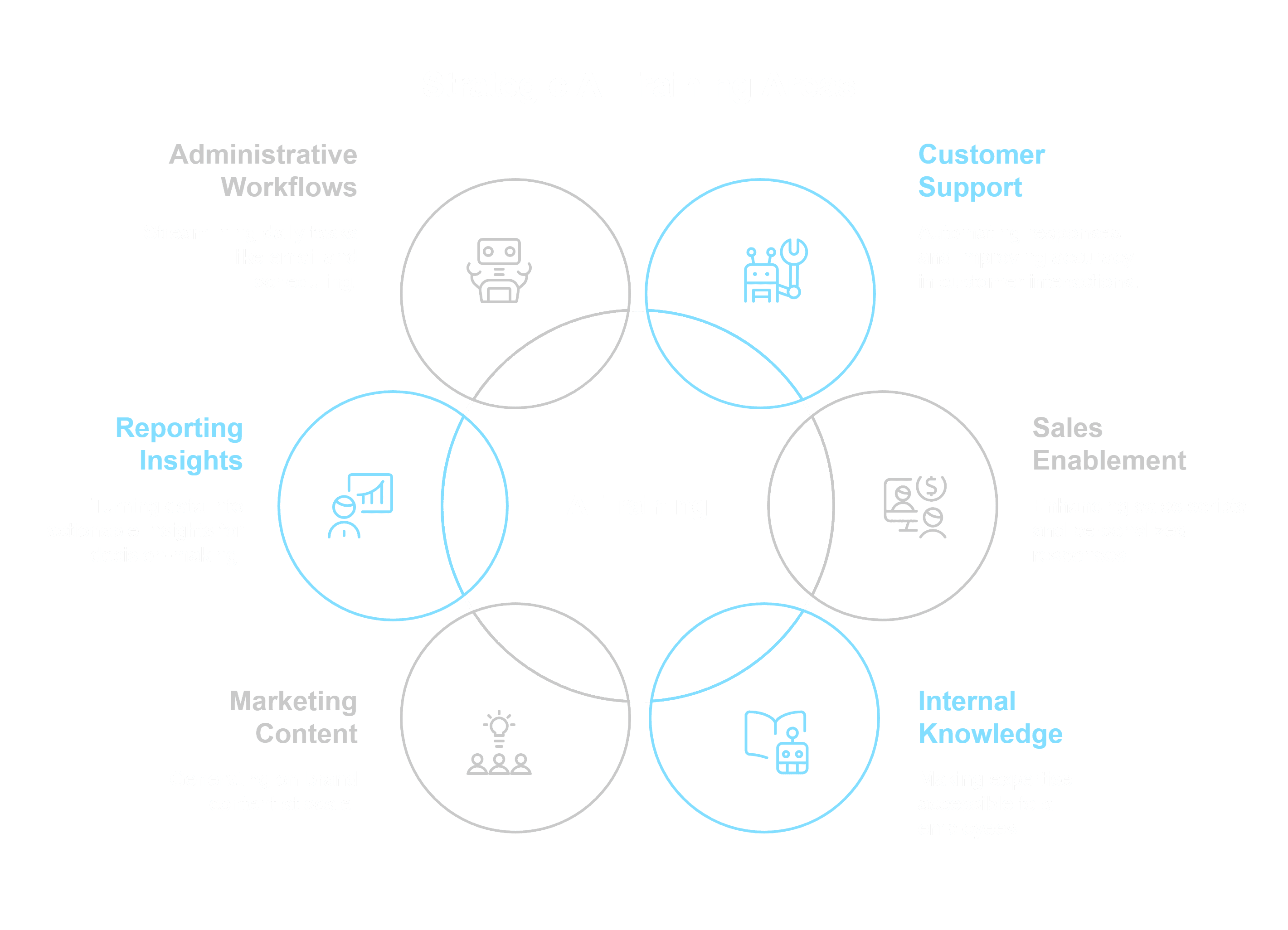
1. Customer Support
AI trained on FAQs, policies, and past support threads can automate responses, improve accuracy, and reduce wait times. It frees agents to focus on more complex issues while improving consistency for customers.
2. Sales and Revenue Enablement
AI can learn your sales scripts, objection handling, and pricing frameworks. A well-trained assistant helps reps craft faster, more personalized responses and maintain consistent messaging that reflects your value proposition.
3. Internal Knowledge and Operations
Every company has key individuals who hold critical knowledge. When AI is trained on onboarding materials and SOPs, that expertise becomes available to everyone. It reduces bottlenecks, speeds up decision-making, and supports training new employees.
4. Marketing and Content Creation
AI trained on brand voice, tone guidelines, and past campaigns can generate on-brand content at scale. It allows teams to produce more copy while preserving clarity and consistency across channels.
5. Reporting and Insights
AI can read reports, summarize findings, and identify trends. This turns data into actionable insights faster and helps leaders focus on decisions instead of spreadsheets.
6. Administrative Workflows
Email drafts, calendar scheduling, and documentation updates are simple yet powerful use cases. Training AI on these patterns can save hours every week across teams.
The key takeaway: start with two or three high-impact functions where AI can deliver measurable value, then build from there.
Why a Project-Based Approach Works Best
Trying to build one AI system for everything usually leads to inconsistent results and frustration. AI performs best when it operates within a defined scope.
A project-based approach means creating focused AI environments for specific purposes:
A support project containing documentation, policies, and escalation rules
A sales project built on pricing logic and messaging
An internal knowledge project centered on workflows and training
This structure improves accuracy, usability, and adoption. It also makes performance easier to track because feedback applies to a single use case.
How to Build AI Projects in Practice
Modern AI platforms such as ChatGPT, Claude, and enterprise assistants now allow you to create structured workspaces where instructions, knowledge, and style persist over time.
Within each project, you can:
Upload relevant documents or connect a RAG knowledge base
Define tone, rules, and format preferences
Fine-tune language consistency with custom examples
Guide how the AI should handle uncertainty or edge cases
This method eliminates repetitive prompting. Instead of telling AI what to do from scratch, you work within a consistent setup that mirrors your business environment.
Keep each project focused. Narrowly scoped AI systems are more reliable, easier to maintain, and deliver faster ROI.
Governance and Data Security Matter
As AI tools become central to business operations, trust and compliance must be part of the implementation plan. When training AI on internal data:
Use secure data connectors that keep information isolated and encrypted
Limit access based on user roles and sensitivity levels
Audit which datasets influence outputs, especially in regulated sectors
Responsible AI practices not only protect your data but also build confidence across teams.
Training Is the Foundation That Scales Value
Training AI on your business is not automation, but it is the foundation that automation depends on. A well-trained AI delivers consistency, accuracy, and speed. Once that foundation is strong, you can integrate it into workflows or even let it trigger automated actions.
Most organizations move through three stages:
Training: Build context and structure around your business data.
Workflow integration: Embed AI in daily tools and repeatable tasks.
Automation: Connect AI with systems to perform tasks end to end.
Training is where AI becomes useful. Workflows and automation are how that usefulness scales.
From AI Experimentation to Real-World Execution
Training AI is not a one-time project. It is a capability that grows through real use.
The most successful organizations start small, measure results, and refine as they go. Feedback loops play a critical role because each interaction reveals new gaps in documentation, tone, or logic that can be improved. Over time, the AI adapts more deeply to your business.
Track improvement through simple benchmarks such as accuracy, adoption rate, resolution time, or time saved. Use these metrics to prove value and guide expansion.
Empowering Teams to Work With AI
Even the best-trained AI is only as effective as the people using it. Team enablement ensures adoption and long-term impact.
Teach employees not just how to use AI, but when to use it. Encourage them to validate results, refine prompts, and share examples of successful use cases. When AI becomes part of daily workflows, resistance fades and productivity grows.
A trained AI system paired with a confident, informed team creates a real competitive advantage.
The Competitive Edge: Integration, Not Access
Access to AI is no longer a differentiator. Almost every organization has it. The real advantage lies in how effectively AI is integrated into your business—your data, your workflows, and your culture.
At Inscend AI, this is exactly what we focus on: helping organizations move from exploration to execution by identifying high-impact use cases, structuring internal knowledge, and creating project-based AI systems that scale.
AI should not just be powerful. It should be aligned, repeatable, and ready to grow with your business.


