
From Strategy to Results: How AI Delivers Measurable Business Impact
SERVICE
AI Strategy
Artificial Intelligence (AI) has become one of the most powerful drivers of business transformation across industries. What was once viewed as a supporting technology is now a core capability shaping how organizations operate, compete, and grow.
AI is no longer about potential. It is about performance. Organizations that apply AI with clarity and intent are realizing tangible gains in efficiency, decision quality, customer experience, and risk management. Those that struggle are not failing because AI lacks capability, but because efforts are fragmented, misaligned, or disconnected from measurable business outcomes.
The difference between success and stagnation is not adoption. It is execution.
When AI initiatives are anchored to business strategy, supported by organizational readiness, and measured against clear performance indicators, AI becomes a scalable engine for value creation rather than a collection of disconnected tools.
Why AI Results Remain Elusive for Many Organizations
AI has broad potential across the enterprise, including improving products and services, driving operational efficiency, and enhancing customer experience. Yet despite significant investment, most organizations fail to realize sustained business impact.
Research indicates that approximately 95 percent of AI initiatives fail to deliver meaningful value, with only 5 percent of enterprises successfully scaling AI to drive measurable outcomes. These outcomes are not constrained by the technology itself.
The real challenges are organizational.
While roughly 75 percent of companies are deploying AI technologies, only 35 percent of employees have received AI training, creating a substantial gap between implementation and effective use. Tools are introduced faster than teams are equipped to use them productively and confidently.
The most common leadership misstep is treating AI as a technology deployment rather than an operating model transformation.
In reality, AI transformation is 80 percent business change and 20 percent technology. Without rethinking processes, decision making structures, incentives, and skills, even the most advanced AI capabilities will underperform.
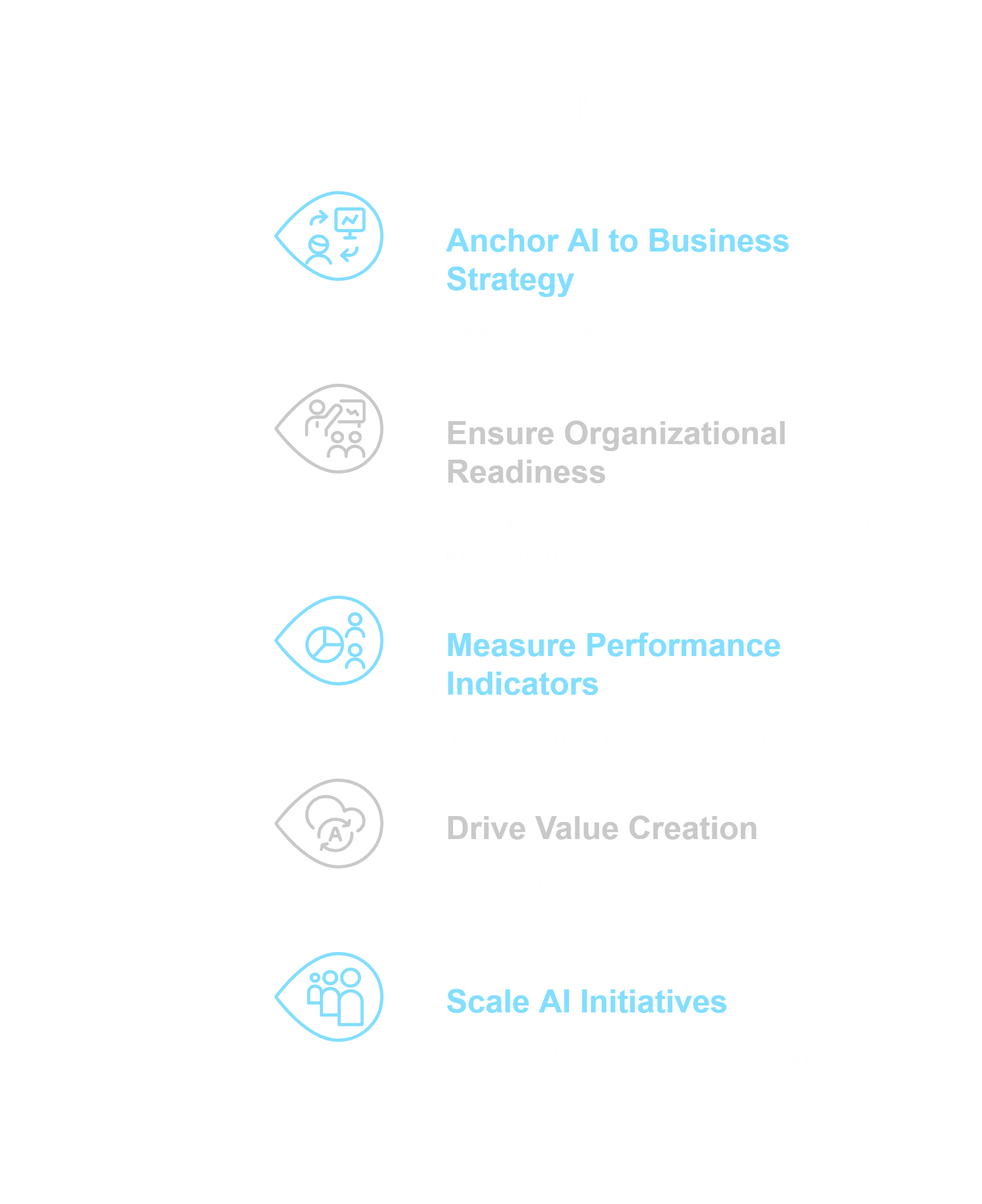
Why Organizational Readiness Determines AI Impact
Organizations that consistently generate value from AI prioritize readiness early and deliberately.
This includes leadership alignment on where AI supports core business priorities, workforce enablement to build confidence and adoption, governance models that balance speed with control, and process redesign that embeds AI directly into daily workflows.
Without this foundation, AI remains additive, layered on top of existing ways of working rather than transforming them. The result is low adoption, unclear return on investment, and increasing internal skepticism.
Readiness is not a one time milestone. It is an ongoing organizational capability that allows AI initiatives to scale responsibly and sustainably as business needs evolve.
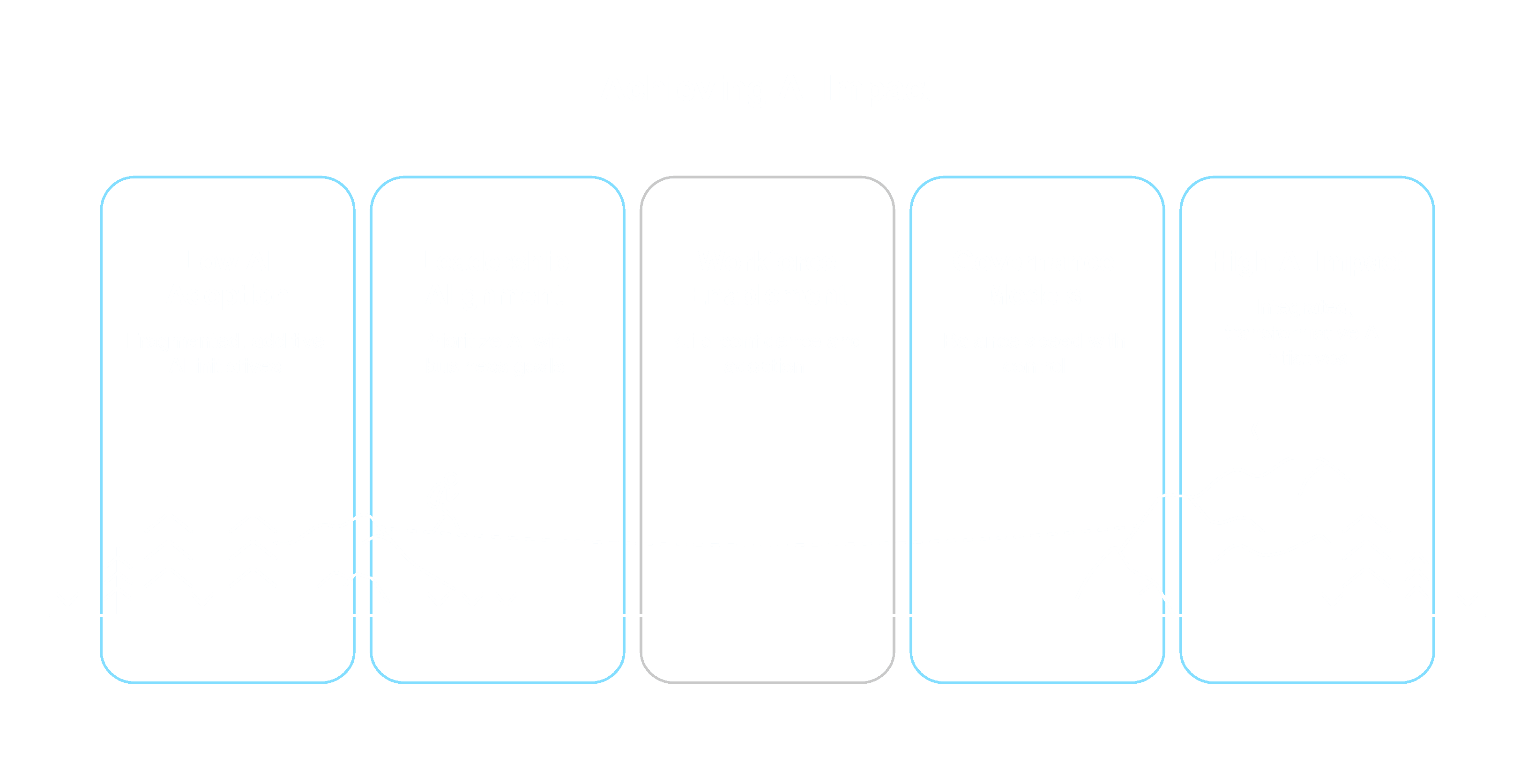
Aligning AI Strategy With Core Business Priorities
One of the most underestimated drivers of AI success is strategic alignment.
Technology is not a goal in itself. AI must be explicitly tied to business objectives such as cost reduction, revenue growth, customer retention, productivity improvement, or risk mitigation. Yet many organizations pursue AI initiatives without clearly defining what success looks like in business terms.
The correct starting point is a clear business strategy. From there, leaders can identify where AI can most effectively accelerate progress against those priorities.
A practical approach is to identify a broad range of potential AI use cases across the organization, then narrow focus to a disciplined portfolio of high impact, long term initiatives, supported by a small number of near term opportunities that deliver visible results and organizational confidence.
This approach allows organizations to define success metrics upfront, measure outcomes consistently, and refine execution based on evidence rather than assumptions.
When alignment is missing, AI initiatives lack direction. Teams struggle to determine whether an initiative should be scaled, refined, paused, or discontinued, leading to wasted investment and reduced credibility.
The primary cause of AI failure is not technology. It is misalignment between AI initiatives and business outcomes.
The benefits outlined in the sections below represent some of the most common and measurable outcomes organizations are achieving with AI today, rather than an exhaustive list of AI’s full potential.
How AI Increases Efficiency and Productivity at Scale
One of AI’s most immediate and measurable benefits is its ability to increase efficiency and productivity across functions.
AI enables organizations to automate repetitive, rules based tasks, streamline workflows end to end, and deliver real time, data driven insights that improve execution speed and quality.
Research shows that AI has the potential to automate 60 to 70 percent of work activities that currently consume employees’ time³. This shift allows teams to focus on higher value work, including strategic planning, problem solving, and innovation.
When deployed effectively, AI does not replace human contribution. It amplifies it by removing friction and enabling people to spend more time on work that requires judgment and context.
How Generative and Agentic AI Improve Decision Making
AI is fundamentally changing how decisions are made across the enterprise.
By rapidly analyzing large and complex data sets, AI surfaces patterns and insights that are difficult for humans to detect, reducing uncertainty and execution risk.
Generative AI enables leaders to interact with data more intuitively. Executives can ask natural language questions, generate executive ready reports in seconds, and model multiple business scenarios by adjusting key variables to support planning and prioritization.
Agentic AI extends these capabilities by acting autonomously on defined objectives. These systems can continuously monitor markets, competitors, and economic signals, dynamically adjust pricing or recommendations in real time, and gather information to present ranked, evidence backed options to decision makers.
Together, these capabilities move organizations from reactive decision making toward proactive and increasingly predictive operating models.
How AI Enables Hyperpersonalized Customer Experiences
In today’s customer centric environment, delivering differentiated experiences is a competitive necessity.
AI enables deeper insight into customer behavior, preferences, and intent. By analyzing large volumes of structured and unstructured data, AI can anticipate needs, personalize recommendations, and optimize engagement across channels.
These capabilities drive higher satisfaction, stronger loyalty, and improved lifetime value, making AI a powerful growth lever, particularly in digital first and ecommerce environments where customer expectations continue to rise.
How AI Strengthens Enterprise Risk Management
AI plays an increasingly important role in enterprise risk management.
By leveraging historical and real time data, AI generates forward looking insights that support more accurate risk identification and mitigation. Its ability to process vast, multi source data sets exceeds human capacity, resulting in more comprehensive and objective analysis.
From fraud detection and credit risk to operational and compliance risk, AI supports faster and more confident decision making grounded in data rather than intuition.
The Core KPIs That Measure AI Business Impact
To assess whether AI initiatives are delivering real value, organizations must track performance metrics that connect technology outcomes to business results. Key indicators include:
Return on Investment (ROI) measured through tangible benefits relative to cost and effort
Adoption and Usage Rates which signal trust, relevance, and real world utility
Customer Experience Impact including NPS, churn, satisfaction, and engagement
Time to Value measuring how quickly initiatives deliver meaningful outcomes
Model Performance such as accuracy, precision, recall, and reliability
Operational Efficiency Gains including reductions in manual effort, waste, defects, and cost per unit
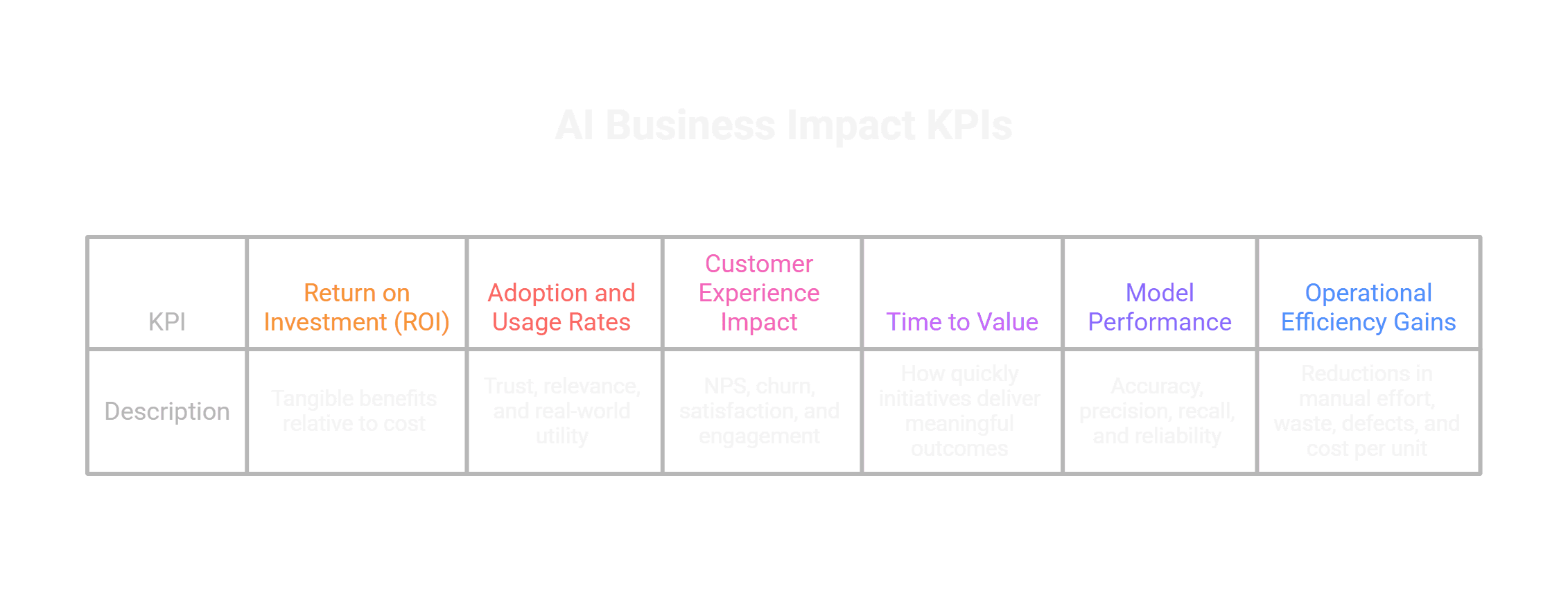
These metrics provide the clarity required to scale successful initiatives and course correct those that fall short.
Turning AI Into Sustained Business Impact
Many organizations are deploying AI, but few are achieving sustained, enterprise level impact because efforts remain fragmented and incremental rather than transformational.
Leaders who are succeeding define a clear long term North Star for AI and redesign their organizations around human AI collaboration. This shift enables flatter structures, fewer managerial layers, and a stronger emphasis on judgment based work, where AI augments decision making rather than replaces it.
Organizations that take this approach move beyond isolated use cases and embed AI into the core of how work gets done. The result is faster execution, higher productivity, and more consistent business outcomes.
AI success is no longer about activity.
It is about alignment, execution, and measurable results.
Sources:
State of AI in Business 2025, MIT
AI skills gap widens: 71% of AI talent are men, while only 22% of baby boomers receive training - reveals randstad data, randstad, 2024
How the best CEOs are the AI moment, McKinsey & Company Podcast, 2025
The economic potential of generative AI, McKinsey & Company, 2023


