
AI Trends to Watch for 2026: From Experimentation to Execution
INDUSTRY
Updates
For the past few years, artificial intelligence has lived in a safe space. Pilots, proofs of concept, innovation labs, and side experiments allowed organizations to explore AI without committing to real operational change. These efforts helped teams understand the technology, test assumptions, and build internal confidence. But as we move into 2026, that era is ending.
AI is no longer something organizations are testing. It is something they are increasingly expected to run on.
What is changing is not just the technology itself, but how comfortable people are using it, how deeply it is embedded into workflows, and how quickly leaders expect measurable outcomes. AI has moved from novelty to necessity. In 2026, the gap between organizations that operationalize AI and those that hesitate will widen rapidly, creating lasting advantages for those that move decisively.
Below are the AI trends that matter most heading into 2026, and what they signal for businesses that want to stay competitive.
Piloting Is Out. Production Is All In.
AI pilots served an important purpose. They helped teams learn, experiment, and build confidence with new tools. They provided proof points and surfaced risks. But pilots alone do not create competitive advantage, especially when they remain disconnected from core operations.
In 2026, organizations are moving decisively from experimentation to production. AI is being deployed directly into core business functions such as customer operations, finance, payments, reporting, and internal support. These deployments come with clear expectations around reliability, governance, security, and return on investment.
This shift is being driven by a simple reality. AI has matured enough to deliver consistent value, and the cost of not using it is becoming visible. Leaders are no longer asking, “Can this work?” They are asking, “Why is this not already live?”
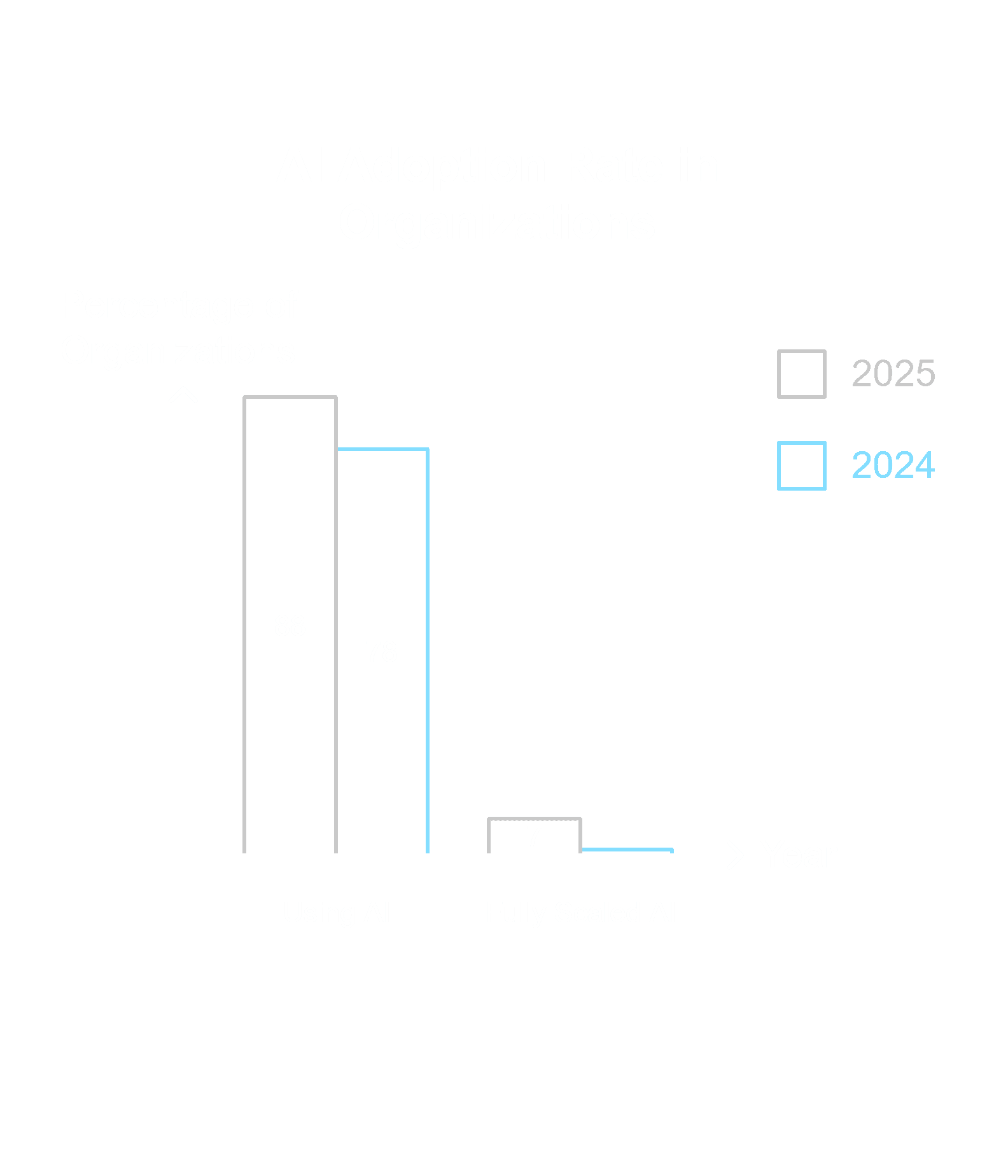
This tension between intent and execution is showing up clearly in the data. The use of AI is becoming widespread across sectors and organizations, largely driven by the rapid adoption of generative AI. Eighty eight percent of organizations reported using AI this year, an increase of ten percentage points from 2024. However, only seven percent of respondents indicated that AI has been fully scaled across their organizations. Most companies remain early in their AI journey, still working through how to redesign workflows and operating models to support AI at scale.¹
This urgency is reinforced by the size of the opportunity now on the table. Generative AI has the potential to automate work activities that absorb sixty to seventy percent of employees’ time, particularly across knowledge work such as drafting, analysis, reporting, customer interactions, and internal coordination.²
For organizations, this is not about replacing roles. It is about reclaiming time, reducing operational drag, and redirecting human effort toward higher value work. In 2026, the productivity gap between organizations that operationalize AI and those that do not will only widen.
From AI Tools to Agentic AI Coworkers
One of the most important evolutions underway is the rise of agentic AI.
Traditional AI tools respond to prompts and execute single tasks. Agentic AI systems go further. They can manage multi step workflows, make decisions within defined guardrails, and operate with a degree of autonomy. In practice, they behave more like digital coworkers than traditional software.
In 2026, AI is shifting from helping with tasks to owning parts of workflows. This shift is especially impactful in operational environments such as payments, customer service, compliance, and internal operations, where rules based processes and high volumes create ideal conditions for automation.
Instead of manually coordinating steps across systems, teams are beginning to rely on AI agents that can monitor activity, trigger actions, escalate exceptions, and complete work end to end. Humans remain in the loop, but their focus shifts toward oversight, judgment, and strategic decision making rather than manual execution.
The result is not fewer people. It is better use of people, with AI handling execution and coordination behind the scenes while humans focus on higher impact work.
AI Adoption Is Now Mass Market
AI adoption has reached a scale that fundamentally changes expectations.
ChatGPT now reports eight hundred million weekly active users, representing roughly ten percent of the global population. That level of adoption is unprecedented for a technology with direct implications for how work gets done.³
This matters because AI familiarity is no longer limited to technical teams or early adopters. Employees are already using AI in their personal lives. Customers are increasingly interacting with AI powered experiences across industries, often without even realizing it. Comfort levels are rising quickly, and expectations are shifting with them.
By 2026, the absence of AI in everyday workflows will feel more noticeable than its presence. Organizations that fail to provide AI enabled tools and processes will increasingly feel out of step with employee expectations and customer demands.

Work Is Being Rewritten. AI Fluency and Learning Velocity Will Define Advantage
AI is reshaping work, but not in the simplistic way headlines often suggest.
Some roles will disappear, particularly those centered on repetitive and manual activities. At the same time, expectations are changing across nearly every function. The most significant shift is not about job titles, but about how work gets done and how quickly people can adapt as AI capabilities evolve.
What is becoming clear is that AI fluency, not role or seniority, will define value in the years ahead. Employees who can work confidently alongside AI systems, guide them, validate outputs, and redesign workflows around them will be far more valuable than those who rely solely on manual execution.
This does not mean everyone needs to understand model architecture or machine learning theory. It means people need to understand what AI can realistically do, where it fits into their work, and how to use it responsibly and effectively.
The pace of AI evolution makes this shift unavoidable. Models improve rapidly. Capabilities expand continuously. New versions arrive faster than most organizations can update formal strategies. For example, ChatGPT is already at version 5.2, reflecting just how quickly leading platforms are evolving.⁴
Competition across the AI ecosystem is also accelerating. Alongside ChatGPT and Claude, Google’s Gemini is scaling quickly. In October 2025 alone, Google Gemini recorded 1.2 billion visits and attracted more than 206 million unique users, underscoring both the speed of adoption and the intensity of innovation across the market.⁵
As a result, static expertise is losing relevance. What matters more is learning velocity. Organizations that treat learning as an ongoing operating principle, rather than a one time initiative, will be best positioned to keep pace. In 2026, adaptability will matter more than tenure, and readiness will matter more than perfection.
What This Means for 2026
The most important AI trend for 2026 is not a specific platform or model. It is normalization.
AI is becoming embedded into everyday operations. It is moving from experimentation to execution, from tools to teammates, and from optional to expected. The organizations that succeed will be those that focus less on novelty and more on integration.
Organizations that approach AI pragmatically, focusing on real workflows, measurable outcomes, and human centered design, will be best positioned to succeed. Those that delay will find it increasingly difficult to catch up as AI becomes table stakes across industries.
AI in 2026 will not feel radical.
It will feel routine.
And that is exactly the point.
Sources
AI at Work but Not at Scale, McKinsey and Company, 2025
The Economic Potential of Generative AI: The Next Productivity Frontier, McKinsey and Company, 2023
Tech Trends 2026, Deloitte Insights
OpenAI product and model release communications, 2025
Google Gemini Statistics: Key Insights and Trends 2025, DO IT Software


