Solutions · AI Ops Platform
Take control of
your AI
operations and
maximize your
ROI.
An AI Ops Platform (“AOP” or the “Platform”) manages
your fleet of AI Agents. It acts as a registry, monitoring
performance and return on investment. It will provide
an inventory of all agents, measure each call, and
confirm the financial impact.
The problem
AI agents are deployed more rapidly than they can be effectively managed.
Teams implement AI agents faster than they can manage them. The result is leadership quickly loses visibility into the number of agents, their costs, and effectiveness. Static inventories are not reliable. Managers need data connected to the fleet’s productivity.
The AI Ops Platform does it for you!
The AI Ops Platform maintains the record, addressing three core questions:
Assessment
1 · What do we have?
Agent Intelligence
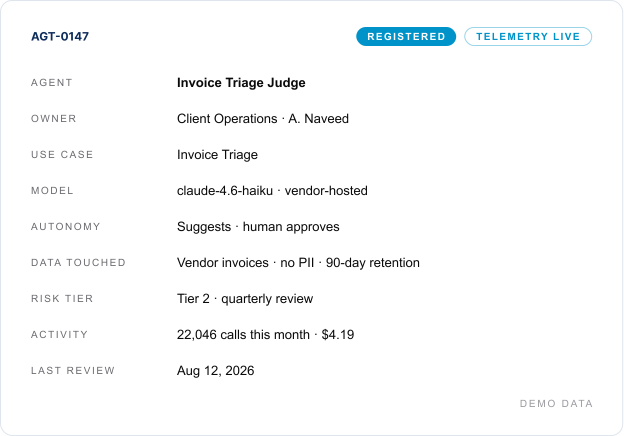
Provides a single record for each agent, including the owner, model, and autonomy level;
Maintains an audit-ready data trail, documenting PII exposure and retention for each agent.
Provides mapping for each agent, ensuring visibility into dependencies, data sources, and regulation.
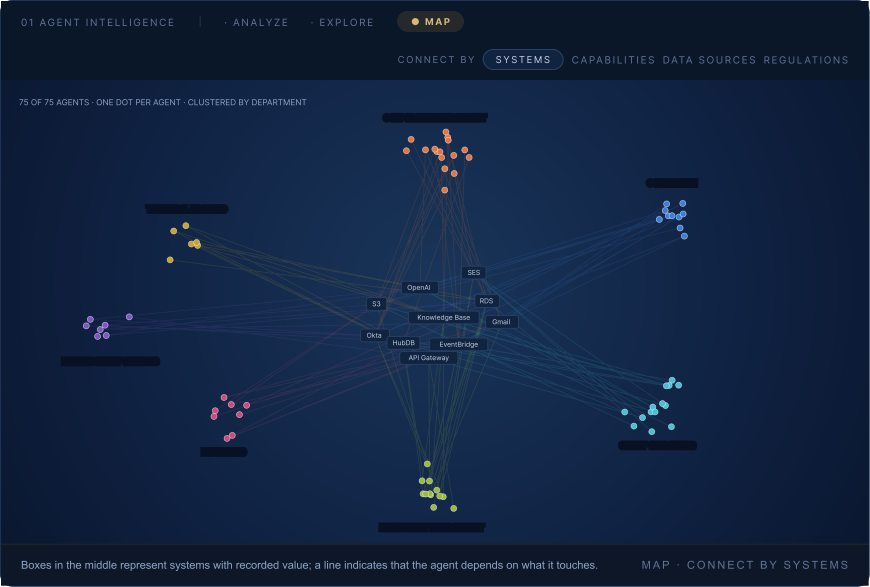
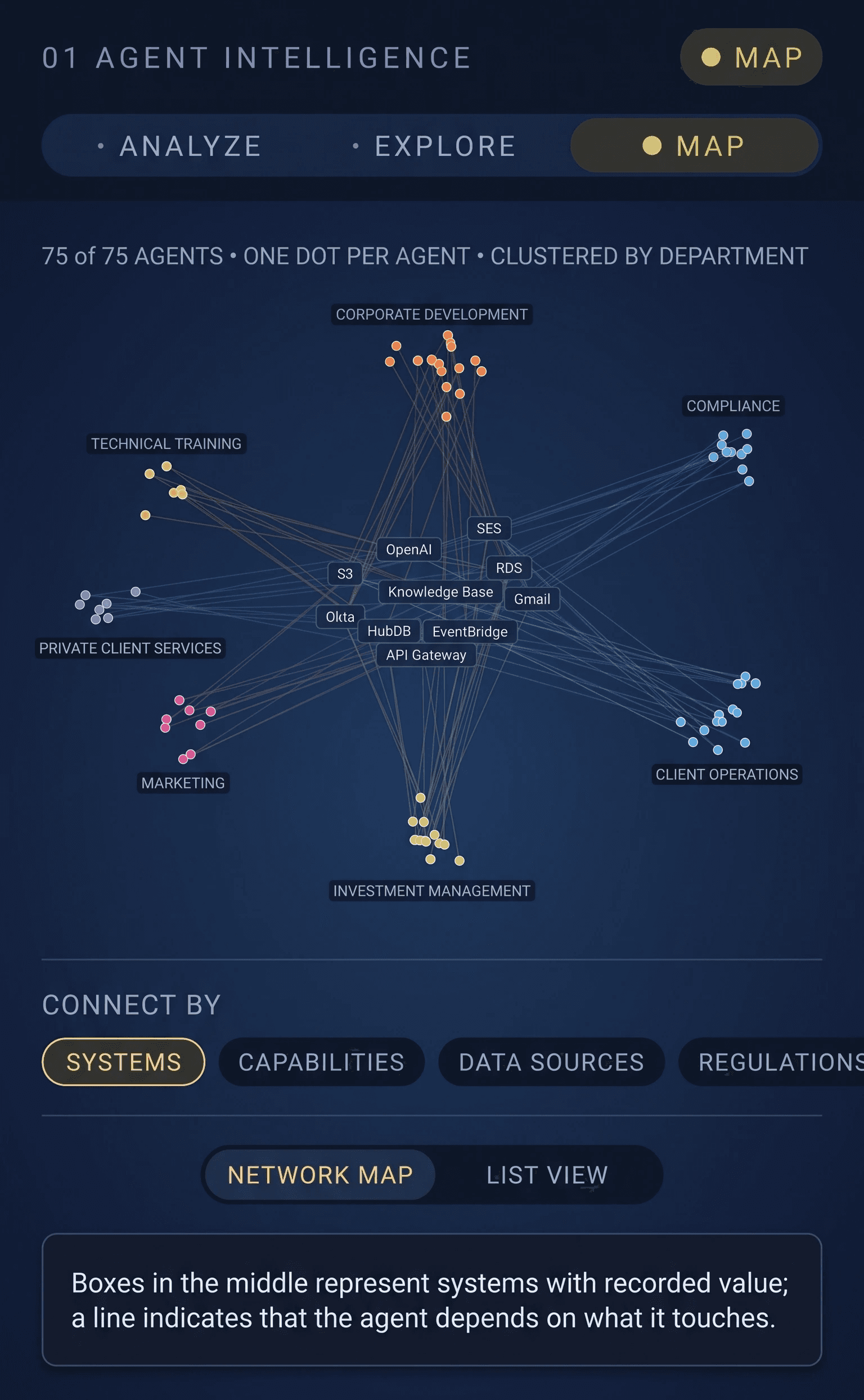
Illustrative example
2 · Is it Working?
Agent Performance
AOP delivers on metrics including volume, error rate, and cost per call measured from live traffic. Metrics can be tailored to organization-specific KPIs, aligning with enterprise reporting and business priorities.
Prevents threshold breaches before they impact budgets or clients.
Ensures full security coverage by detecting unregistered agents as soon as they are active.


Illustrative example
3 · Is it Worth It?
AI Return
AOP calculates returns in real dollars: by using department rates to assess the cost of the agent, you can compare against other solutions;
AOP summarizes aggregate value: from the agent, to use case, to department. Everything can be measured against FTE equivalents.
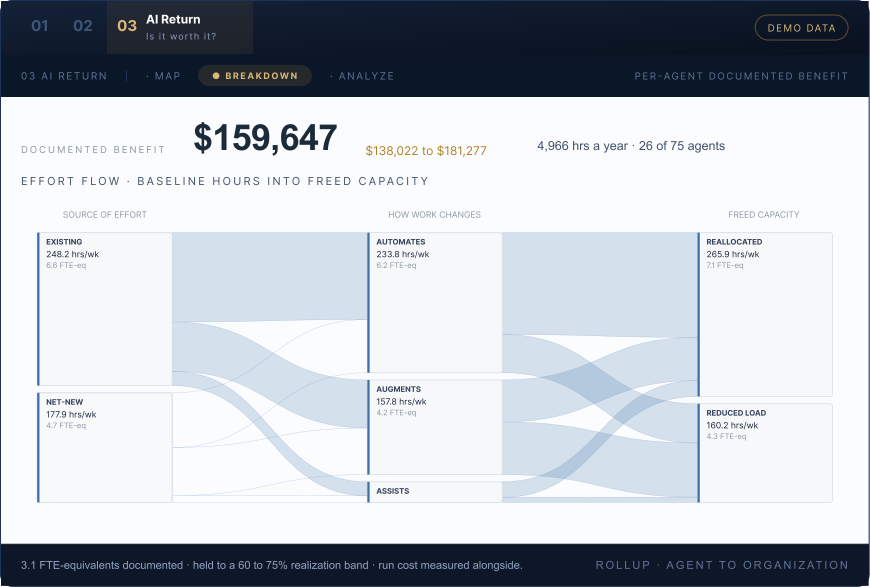
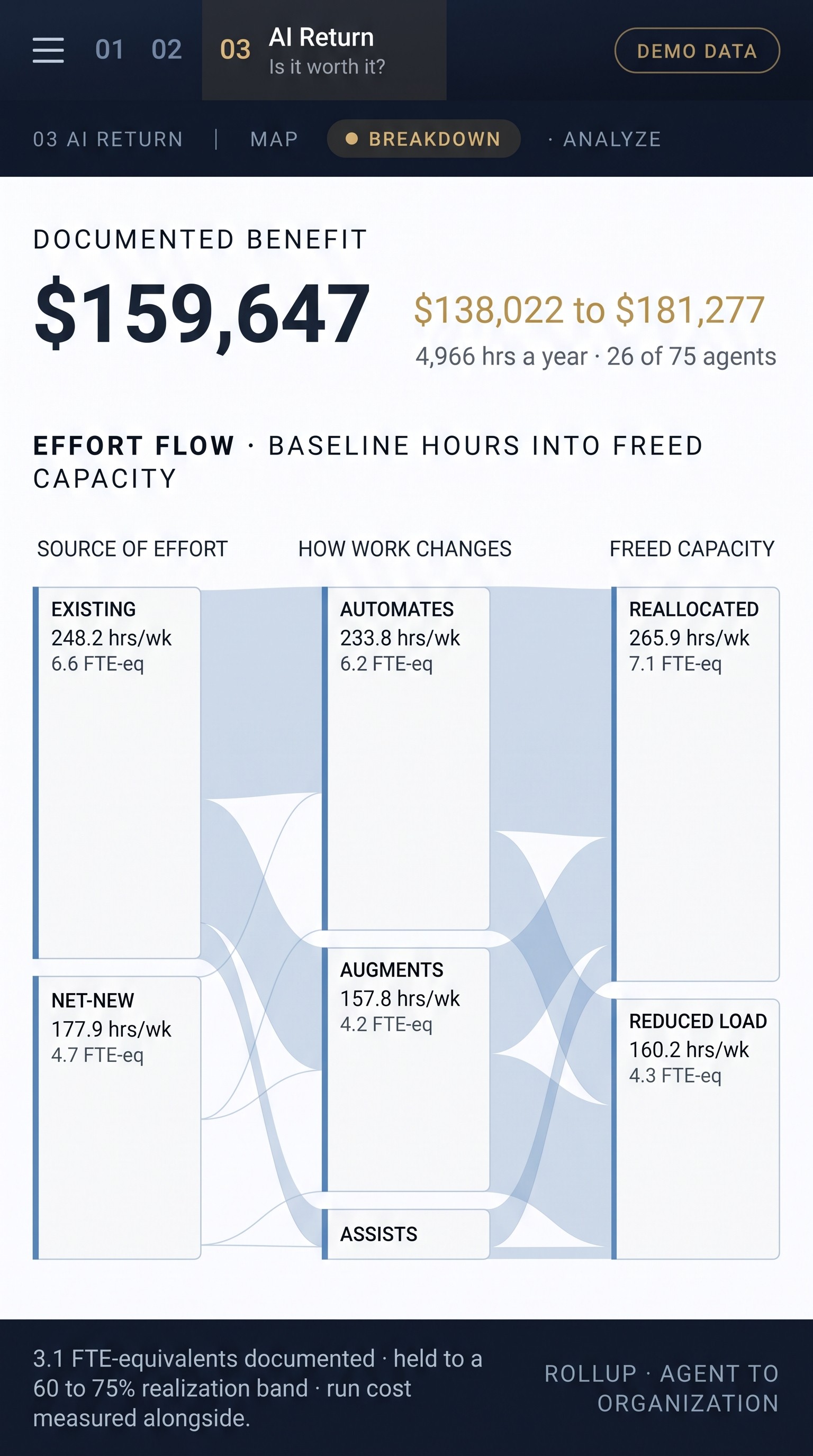
Illustrative example
GOVERNANCE
All agents are registered before deployment.
All agents are registered using a structured intake process: AOP ensures the Agents are clear on the purpose, data handling, and risk requirements before joining the fleet. The registry maintains the single record for each agent. The methodology ensures consistent measurement against firm goals by evaluating usage, impact, accuracy and operational health.

Why now
Regulatory expectations are shifting from guidance to mandatory requirements, making readiness essential for deployment.
OSFI’s Guideline E-23 takes effect May 1, 2027, applying to all federally regulated financial institutions. It requires enterprise-wide model risk management covering AI and machine learning models from any source. The EU AI Act and ISO 42001 point in the same direction: know your inventory, monitor it continuously, and document the lifecycle. An agent registry wired to live telemetry is that backbone.
OSFI E-23 · Takes effect
Enterprise-wide model risk management, every FRFI, models from any source.
OSFI E-23
Canada
Model risk management for Canadian FRFIs ·
effective May 1, 2027
EU AI Act
European Union
Risk-based obligations for AI systems in the EU market
ISO/IEC 42001
Global
The management-system standard for AI
NIST AI RMF
United States
The reference framework for AI risk in North America
The AI Ops Platform supports readiness against these frameworks. Compliance obligations remain with your institution and its advisors.
Getting started
Register, measure, and demonstrate value.
Start with the first step below.

01
Register
Inventory all agents and establish the registry, risk profile, and intake process.

02
Measure
Connect the platform to your runtime. Performance and cost metrics are collected from live calls.

03
Prove
Develop a value model for quarterly review, including hours, dollars, and run cost.
Registration is based on AI Governance, measurement on AI Systems, and proof on AI Strategy. Your team operates the platform, with AI Enablement supporting effective adoption.
Frequently asked questions.
Is this SaaS?
+
What can it observe?
+
Do we need your other services to use it?
+
We already have dashboards. Why this?
+
How long does deployment take?
+
Where does our data reside?
+
Which models and runtimes are supported?
+
How does this support OSFI E-23 readiness?
+
How is it priced?
+

